
Otio Review 2026: Pricing, Pros, Cons and Alternatives
What Otio's Free, Lite, Go and Pro plans buy in uploads, storage and parallel chats, where its no-source-cap promise has limits, and how it compares with Gemini Notebook (NotebookLM), ChatGPT, Elicit and Humata.

Otio is worth it in 2026 if you research across many PDFs, papers and videos and want ChatGPT, Claude, Gemini and other models in one workspace, and Lite at $7 a month (billed yearly, $84 a year) is the plan most people should try after Free. Go costs $18 a month and Pro $45 a month, both on yearly billing, and every plan, including Free, gets all models, Deep Research and page-level citations. Paid tiers differ by volume: daily uploads, storage, PDF length and parallel chats. The catch: charges are generally non-refundable, and Otio's terms say payments are processed in GBP unless stated otherwise. Closest alternatives: Gemini Notebook (NotebookLM), ChatGPT, Elicit and Humata.
Key factsBest for: Researchers who chat across many PDFs, papers and videos…
- An AI research workspace with every major model on every plan and answers cited to the page.
- Entry plan: Free with every AI model, 10 uploads a day and 50MB of storage
- Cheapest paid plan: Lite at $7 a month on yearly billing
- Paid tiers differ by: Uploads, storage, PDF length, parallel chats and AI usage, not features
- Alternatives covered: Gemini Notebook (NotebookLM), ChatGPT, Elicit, Humata
Pros
- All models, Deep Research and page-level citations are included on Free, not locked to a top tier.
- PDFs up to 2,000 pages and 1GB of storage on Pro.
- Compare two models side by side on the same sources.
Cons
- Charges are generally non-refundable, with refunds only for mistaken sign-ups or major faults within 7 days.
- Free storage is 50MB, so the no-source-cap promise is limited by space.
- Terms say payments are processed in GBP unless stated otherwise.
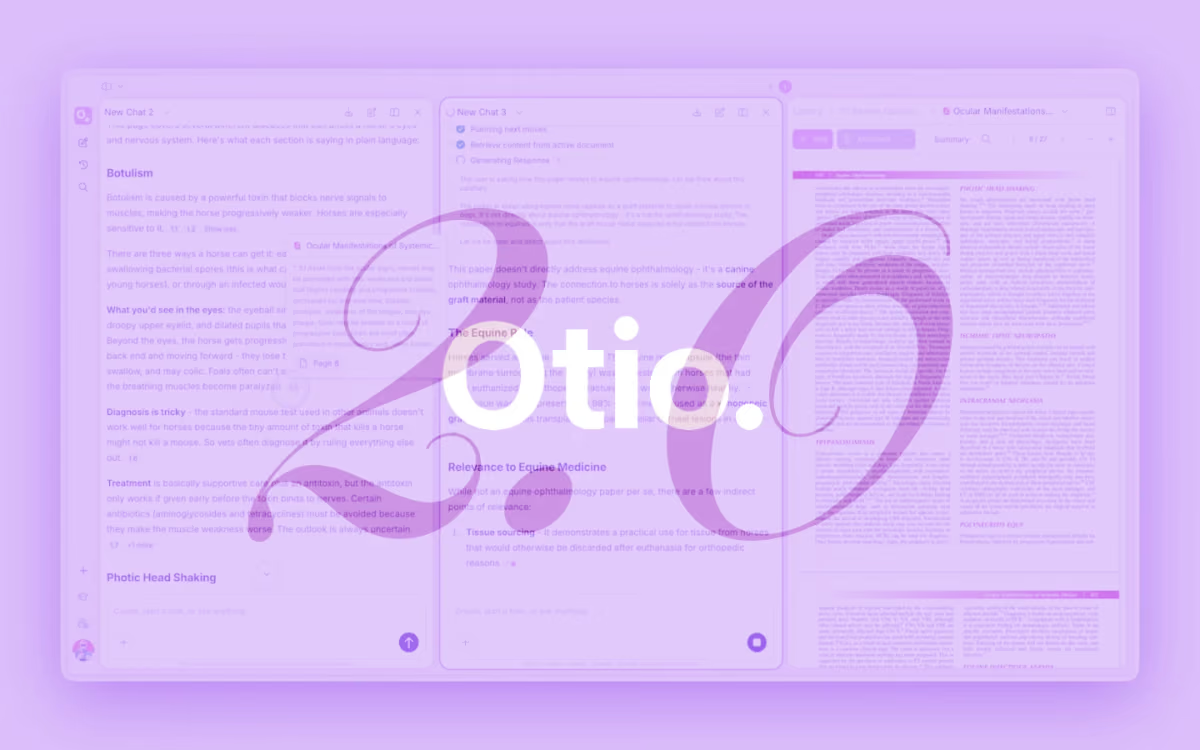
Otio sells one idea: you should not pay more to reach a better model. Every plan, Free included, gets the same models and Deep Research, so what you buy is volume, not features. That makes Otio unusually easy to judge.
If the free allowance covers your reading, it costs nothing; if it does not, the question is how many uploads, how much storage and how long a PDF you need.
This review is for students, academics, consultants and analysts deciding whether Otio earns a subscription next to tools they may already pay for, like a Google AI plan or ChatGPT.
Plan prices and limits were read on Otio's pricing page on November 10, 2026 (the page itself says it was last updated July 7, 2026), and billing rules come from Otio's terms and refund policy. The verdicts rest on published limits and the cost scenarios we computed from them.
Toolradar data: of the 120 AI research tools tracked by Toolradar, the software directory we run, 54% offer a free plan, and among the 32 with a verified entry price the median entry plan costs $11 a month (as of November 5, 2026). Otio's Lite price sits under that median, though only on yearly billing.
What is Otio?
Otio is an AI research workspace that answers from the sources you give it: PDFs, web pages, YouTube videos, podcasts, audio, spreadsheets and notes. Otio says it generates answers based only on information you provide and tells you when it cannot find an answer, and every answer is cited to the exact page or timestamp. It is built by Frontdoor Labs Ltd, a London company, and claims more than 200,000 users.
The model menu is the main difference from a single-vendor tool. Otio lists ChatGPT, Claude, Gemini, Grok, Llama, DeepSeek and Moonshot models, plus Otio Auto, a router with Auto, Fast and Expert quick-picks. You can retry an answer with another model or compare two models side by side on the same sources.
No plan hides a model, which is the opposite of how ChatGPT, Gemini and most rivals price their tiers.
Around the chat sit the research tools: Deep Research across your sources and the open web, editable notes generated from a PDF or video, charts from uploaded CSVs, and delivery of outputs by email, Google Drive or Telegram on paid plans.
Work is organised in Spaces, each with its own source library and chat history. There is a web app, desktop apps for Mac, Windows and Linux, an iPhone app and a Chrome extension.
How Otio works
You sign up for Free with no card, upload sources into a Space and chat across all of them at once. Free is a real working plan, not a teaser: it keeps every model and Deep Research, but caps you at 10 uploads a day, 50MB of storage, 1 Space and 2 parallel chats, with limited monthly AI usage and a basic PDF viewer.
Paid plans raise volume in steps. Lite allows 50 uploads a day, 250MB of storage, PDFs up to 500 pages, 2 Spaces and 5 parallel chats, and adds multi-step research workflows, the reader view, Zotero and Mendeley on desktop, audio recording and delivery to email or Drive.
Go gives 3x the monthly AI usage, 250 uploads a day, 500MB and PDFs up to 1,000 pages. Pro gives 10x, 500 uploads a day, 1GB and PDFs up to 2,000 pages.
The "no source caps" promise needs a footnote. Otio does not cap how many sources sit in your library, but storage does, and the Free plan's allowance fills quickly with scanned PDFs, so in practice the limit you meet is megabytes rather than files.
Gemini Notebook works the other way, with a count limit of 50 sources per notebook on its free tier and 300 on Google AI Pro, per Google's plan limits page.
Billing follows standard subscription rules, with two details worth knowing before you pay. Otio's terms say payments are processed in GBP unless otherwise specified and subscriptions renew automatically for the same term.
Its refund policy says charges are generally non-refundable, with a refund route only for mistaken sign-ups or a major platform fault, raised within 7 days.
Otio key features
Otio pricing
Otio prints four personal plans on its pricing page, verified on November 10, 2026, and the prices shown are yearly billing, which Otio labels "Save 50%". Lite costs $84 a year, Go $216 and Pro $540; Free costs nothing.
Check the current monthly-billing price on Otio's site before choosing month to month. A separate Business tab covers teams, and a banner offering 50% off for 3 months with a code is a limited-time promotion, not the list price.
On a one-year cost, Otio Lite is the cheapest paid option here. By our arithmetic on printed prices: Otio Lite is $84 for the year on yearly billing; Humata Expert at $9.99 a month comes to $119.88; Google AI Pro at $19.99 a month comes to $239.88; and Elicit Pro is billed $588 a year. Otio Go, at $216 a year, still costs less than twelve months of Google AI Pro.
Heavy readers should also count overages. Humata Expert includes 500 pages a month and charges $0.02 for each extra page, so reading 1,000 pages a month adds $10, which makes it $239.88 a year in total, the same as Google AI Pro. Otio has no per-page fee; you hit the daily upload, storage or PDF-length limit first and then move up a plan.
Gemini Notebook is free with a Google account, and Google AI Plus at $4.99 a month raises its limits to 200 notebooks and 100 sources per notebook. ChatGPT sells Go, Plus and Pro plans; check the current price on ChatGPT's site.
| Plan | Price | Best for |
|---|---|---|
| Otio Free | $0 | All models, Deep Research, 10 uploads a day, 50MB storage, 1 Space, 2 parallel chats |
| Otio Lite | $7/mo billed yearly ($84/yr) | 50 uploads a day, 250MB, PDFs up to 500 pages, 2 Spaces, 5 parallel chats, workflows |
| Otio Go | $18/mo billed yearly ($216/yr) | 3x AI usage, 250 uploads a day, 500MB, PDFs up to 1,000 pages, 5 Spaces, 10 chats |
| Otio Pro | $45/mo billed yearly ($540/yr) | 10x AI usage, 500 uploads a day, 1GB, PDFs up to 2,000 pages, 10+ parallel chats |
| Google AI Pro (Gemini Notebook) | $19.99/mo | 500 notebooks, 300 sources per notebook, Gemini 4 Argon |
| Elicit Pro | $49/user/mo billed $588/yr | Systematic review workflow screening 5,000 papers, custom extractions, API access |
| Humata Expert | $9.99/mo | 500 pages a month for up to 3 people, extra pages at 2 cents each |
Otio pros and cons
What we like
- All models, Deep Research and page-level citations are included on Free, not locked to a top tier.
- PDFs up to 2,000 pages and 1GB of storage on Pro.
- Compare two models side by side on the same sources.
What could be better
- Charges are generally non-refundable, with refunds only for mistaken sign-ups or major faults within 7 days.
- Free storage is 50MB, so the no-source-cap promise is limited by space.
- Terms say payments are processed in GBP unless stated otherwise.
Who Otio is for
Otio is the right pick for people whose research lives in dozens of long documents: PhD students running a literature review, consultants working through client files, lawyers and analysts pulling facts out of reports.
The citation to the exact page or timestamp is what makes it usable for work that has to be checked. If that is you, start on Free, and move to Lite when the free upload and storage limits start to slow your week down.
Go and Pro fit daily, heavy research. Go's 1,000-page PDF ceiling covers long reports and books, and Pro's 2,000-page ceiling and 1GB of storage suit people who load whole document sets. Both make most sense on yearly billing, which is how Otio prints them.
It is a weaker fit in three cases. If your sources are mostly Google Docs and you already pay for a Google AI plan, Gemini Notebook is included; see our NotebookLM review and NotebookLM pricing explained.
If you need peer-reviewed papers found for you rather than your own files analysed, our Elicit review and our Consensus review fit better.
And if one strong chatbot covers you, compare NotebookLM vs ChatGPT before adding another subscription.
Best Otio alternatives
If Otio is not the right fit, these are the closest options.
| Tool | Best for | Starts at | |
|---|---|---|---|
| Otio | Researchers who chat across many PDFs, papers and videos and want several AI models in one place. | Free plan | Visit → |
| Gemini Notebook (NotebookLM) | Google users who want free source-grounded chat and higher limits bundled with a Google AI plan. | Free with a Google account | Visit → |
| ChatGPT | People who want one general assistant with file uploads and Projects rather than a dedicated research workspace. | Free plan · Go $8/mo · Plus $20/mo · Pro $100/mo | Visit → |
| Elicit | Academics and industry researchers running systematic reviews across published papers. | Free plan · Plus $11/mo per user · Pro $39/mo per user · Scale $89/mo | Visit → |
| Humata | Small teams that chat with PDFs and prefer paying by pages read. | Free plan · Expert $9.99/mo · Team $49/mo per user · custom-priced pla | Visit → |


The bottom line
Otio is worth paying for if you read across many long sources every week, and Lite is the plan that earns its price first. Its strongest argument is that the free plan already includes every model and Deep Research, so you can judge the product before you pay anything. On yearly billing it undercuts Humata, Google AI Pro and Elicit for a year of use.
Check two things before you buy a yearly plan. Charges are generally non-refundable, and the 7-day refund route covers mistaken sign-ups or major faults, not a change of mind; and payments are processed in GBP unless stated otherwise, so ask your card issuer about foreign transaction fees.
If you already pay for a Google AI plan, try Gemini Notebook first.
For more options see our NotebookLM alternatives list, our Humata review, the best AI tools for students and the best free AI summarizers.
Methodology: Otio's plan prices and limits were read on its pricing page on November 10, 2026, and billing and refund rules on its terms and refund policy the same day. Competitor prices come from the pricing pages of Google AI, Elicit and Humata, and Gemini Notebook limits from Google's plan limits page, on the same date.
Yearly totals and overage costs are our arithmetic on printed prices. The Toolradar figures come from its AI research data, dated November 5, 2026. We give no star rating of our own.
Sources: Otio pricing, Otio terms, Otio refund policy, Google AI plans, Gemini Notebook plan limits, ChatGPT pricing, Elicit pricing, Humata pricing, NotebookLM on Toolradar, ChatGPT on Toolradar, Elicit on Toolradar, Humata on Toolradar.
Cite this: AIpresso, "Otio Review 2026: Pricing, Pros, Cons and Alternatives", November 2026.
Frequently asked questions
How much does Otio cost in 2026?
Is Otio free?
What is the difference between Otio Lite, Go and Pro?
Is Otio better than NotebookLM?
Can I get a refund from Otio?
What are the best Otio alternatives?
Sources
Prices and plan details come from each vendor's own pricing page, re-checked by the Toolradar pricing tracker.
- ChatGPT pricingchecked Sep 2026
- Elicit pricingchecked Sep 2026
Some offers on this page may be paid placements or contain affiliate links.
Get the AIpresso brief
Free daily newsletter, read in 5 minutes.
Subscribe free